
Sourcing Original Isuzu Engine Parts: A Practical Guide for Fleet Operators and Equipment Managers
When your excavator stops mid-shift or a truck breaks down on a critical job site, the cost isn't just the repair—it's lost productivity, missed deadlines, and frustrated teams. Original Isuzu engine parts form the backbone of reliable equipment performance across construction machinery and commercial fleets. Understanding what makes these components essential, how to identify genuine options, and where to source them can mean the difference between a minor service interruption and a costly operational crisis.
Understanding Isuzu Engine Architecture and Common Failure Points
Isuzu diesel engines power some of the world's most demanding equipment. The 6UZ1, 6WG1, and 6HK1 series represent decades of engineering refinement, yet even robust designs experience wear patterns that fleet managers need to recognize early.
The common rail fuel injection system in modern Isuzu engines operates at pressures exceeding 1,600 bar. Fuel injectors face constant thermal cycling and combustion shock, making them among the first components to show signs of degradation. When injectors drift out of specification, fuel atomization suffers, combustion becomes uneven, and fuel consumption climbs noticeably.
Turbochargers in heavy-duty Isuzu engines handle boost pressures that create thermal and mechanical stress on the rotating assembly. The bearing surfaces experience wear over thousands of hours. A turbo running on marginal clearances generates vibration that radiates through the engine block, causing secondary damage to gaskets and seals if left unchecked.
Cylinder liners, pistons, and ring sets form a sealed combustion chamber. Over time, abrasive wear particles from contaminated fuel or degraded oil create micro-scoring on liner walls. This allows combustion gases to slip past the rings, reducing compression and power output while increasing blowby gases that pressure the crankcase.
Why Compatibility Matters More Than Price Alone
Original Isuzu engine parts carry a tolerance stack tighter than many aftermarket alternatives. A piston engineered for the 4HK1 series matches the cylinder bore diameter and ring groove geometry within tight tolerances. Install a looser-tolerance piston from an unknown supplier, and you're accepting increased blowby, oil consumption, and eventual ring failure.
The same principle applies to main bearings, connecting rod bearings, and oil seals. Bearings running at reduced clearance generate excess heat. Seals fitted with improper lip geometry leak oil under normal operating conditions. These aren't dramatic failures—they're silent performance degradations that compound over months.
For operators managing fleets of Hitachi, Sumitomo, or Sany excavators with Isuzu powerplants, this compatibility precision becomes a competitive advantage. Equipment that maintains consistent power output and fuel economy keeps projects on schedule and budgets intact.
Core Engine Components and Their Roles
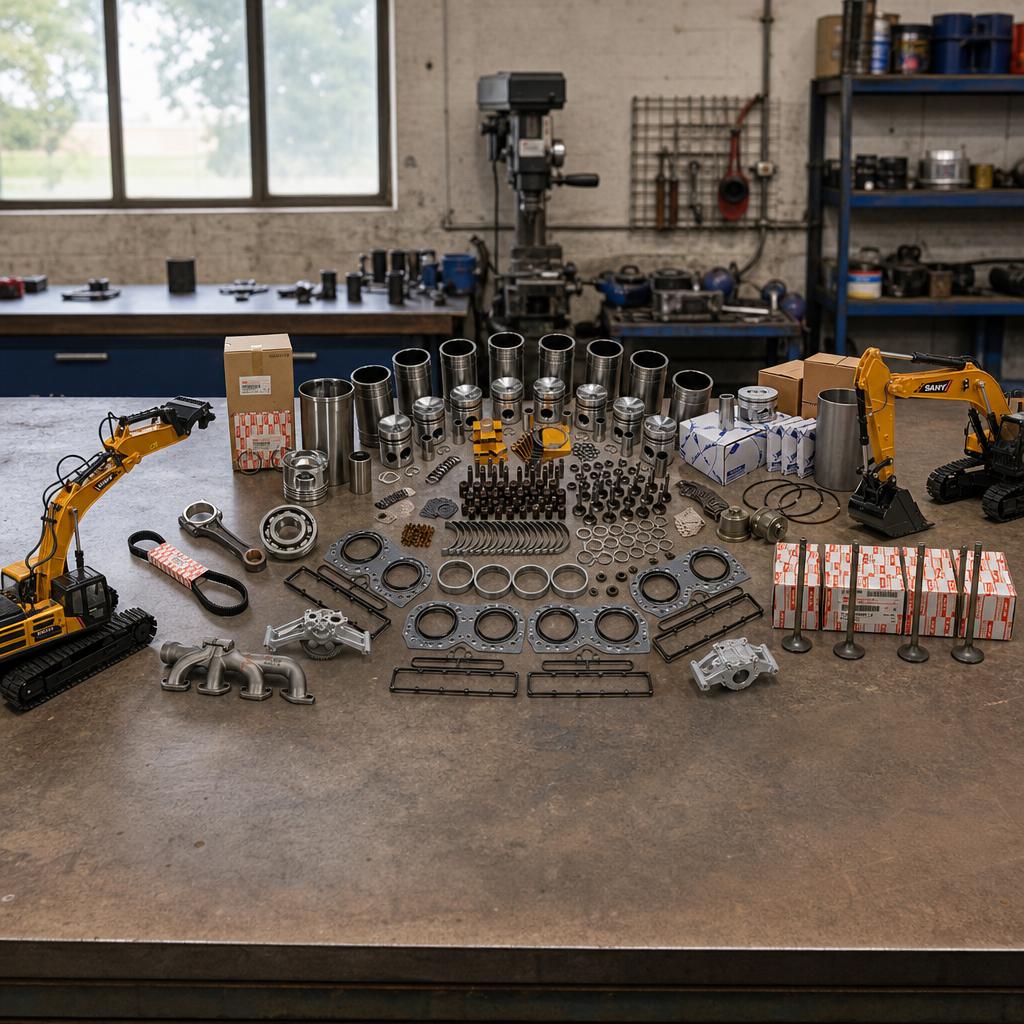
Heavy-duty engine overhauls typically involve replacing multiple component categories simultaneously. Understanding what each plays in engine operation helps operators make informed maintenance decisions.
Crankshafts and Cylinder Blocks form the structural foundation. These cast or forged steel parts withstand combustion pressures and convert reciprocating piston motion into rotational power. Original Isuzu designs incorporate specific metallurgy and heat treatment that ensures durability across the engine's rated cycle life.
Fuel System Components including pumps, injectors, and high-pressure lines deliver precisely timed fuel charges into the combustion chamber. Common rail technology requires exact calibration. Replacing fuel injectors with original Isuzu parts ensures spray patterns and flow rates match engine control module expectations.
Air and Cooling Systems maintain thermal stability. Turbochargers compress incoming air, raising its temperature. Aftercoolers reduce this heat before air enters cylinders. Original components maintain the specific flow paths and pressure drops the engine was calibrated for.
Gasket and Seal Kits prevent internal and external leakage. These materials must resist combustion temperatures on one side and coolant or oil exposure on the other. Original kits use elastomers and facing materials engineered for Isuzu's specific thermal and chemical environment.
Bearings and Connecting Rods translate piston motion while maintaining precise clearances. Connecting rod material and bearing composition were selected through engineering and testing to handle peak firing pressures without deformation.
Supported Engine Series and Application Mapping
Original Isuzu engine parts span a wide range of models, each serving specific machinery categories.
The 6UZ1 and 6WG1 series power larger excavators and wheel loaders where peak torque and fuel efficiency matter. The 6HK1 delivers power in a more compact envelope, favoring mid-size equipment. The 4HK1 steps down to smaller dozers and compact excavators. Lighter-duty equipment like agricultural machinery runs the 4LE1, 4LE2, or 3LD1 series.
| Engine Series | Typical Power Range | Primary Equipment | Key Characteristics |
|---|---|---|---|
| 6UZ1 | 200+ hp | Large excavators, wheel loaders | High torque, common rail injection |
| 6WG1 | 180-220 hp | Excavators, dumpers | Proven reliability, widespread availability |
| 6HK1 | 150-190 hp | Mid-size excavators, compactors | Compact design, high power density |
| 4HK1 | 130-160 hp | Smaller excavators, loaders | Efficient, rapid fuel response |
| 4LE1/4LE2 | 80-110 hp | Agricultural machinery, gensets | Lower fuel consumption |
| 3LD1/3LD2 | 40-60 hp | Small equipment, stationary use | Robust, simple architecture |
This compatibility extends across brands. Hitachi, Sumitomo, Kobelco, and Case excavators frequently run Isuzu engines. Sany and Xugong machines in the Chinese market often receive Isuzu powerplants. MAHLE series parts also integrate with these engines, offering alternative sourcing for specific components like pistons, valve assemblies, and cylinder liners.
Identifying When Original Parts Are Worth the Investment
Not every engine repair requires original components across the board. Understanding which parts justify the premium helps operators balance cost and reliability.
Critical-to-Function Components like fuel injectors, turbochargers, and crankshafts warrant original specifications. Failure in these areas either stops the engine immediately or leads to rapid secondary damage. The downtime cost far exceeds the component price premium.
High-Wear Items like piston rings, gasket kits, and oil seals benefit from original specifications. These parts experience direct combustion or fluid exposure. Using matched sets ensures consistent performance and extends intervals between major overhauls.
Structural Components like cylinder blocks and connecting rods rarely fail in service. Once installed, they remain in place for the engine's lifetime. Sourcing original parts during overhauls ensures you're not introducing metallurgical incompatibilities that cause fatigue failures years later.
Auxiliary Components like alternators, water pumps, and AC compressors often have longer part lifespans. Remanufactured or equivalent parts sometimes make economic sense for these items, provided they carry proper core exchange programs and warranties.
Logistics and Sourcing Original Isuzu Engine Parts in China
For operations in China, sourcing original Isuzu engine parts involves understanding the distribution network and lead times. Guangzhou-based suppliers maintain direct relationships with Isuzu's parts distribution channels, offering inventory availability that regional shops cannot match.
Sea freight delivers large shipments at lower cost but requires planning weeks in advance. Air freight serves urgent repairs but commands premium pricing. Suppliers maintaining local stock for common components like gasket kits, oil seals, and fuel filters bridge this gap, allowing emergency repairs without long waits.
Verifying authenticity requires checking part markings, packaging, and supplier credentials. Original Isuzu parts carry specific part numbering systems and manufacturing dates. Counterfeit components occasionally circulate through informal channels, and installing them risks engine damage far exceeding the money saved.
Establishing relationships with certified dealers ensures consistent part availability and technical support. These dealers can cross-reference OEM part numbers with machinery applications, reducing ordering errors.
Technical Specifications and Performance Standards
Original Isuzu engine parts meet strict tolerance and material specifications that ensure interchangeability across production runs spanning years.
Fuel injectors deliver metered fuel charges with timing precision. Spray pattern cone angles and droplet sizes fall within narrow ranges to ensure complete combustion and minimal emissions.
Piston ring end gaps must fall within specific tolerances depending on the engine series to prevent ring binding or gas leakage during thermal cycling.
Bearing clearances balance hydrodynamic film thickness against thermal stability. Clearances too tight generate excess heat; clearances too loose allow metal-to-metal contact. Original bearing sets come matched to specific engine families.
Valve seat inserts, valve guides, and poppet valves work as matched assemblies. Original specifications maintain combustion chamber geometry and gas flow paths the engine was calibrated for during development.
These specifications extend to materials. Nodular cast iron cylinder blocks, forged steel crankshafts, and precision-cast turbo housings were selected after extensive testing across temperature extremes and load variations.
Common Maintenance Scenarios and Component Requirements
Routine Overhauls for engines exceeding 5,000 operating hours typically involve replacing gasket kits, oil seals, and fuel filters. These components degrade predictably, and regular replacement prevents leakage and maintains system integrity. Original gasket sets ensure exact fitment without shimming or modification.
Turbocharger Replacement occurs when boost pressure drops or exhaust temperatures climb abnormally. Original turbo units carry factory calibration matched to the engine's air intake and fuel injection systems. Mismatched turbos create over-boost conditions or insufficient air supply.
Fuel System Service addresses injector fouling, pump wear, or contaminated fuel lines. High-pressure lines carrying 1,600+ bar fuel must maintain structural integrity. Original hose assemblies use reinforced inner tubes and correct SAE flange connections.
Bearing and Rod Assembly Replacement becomes necessary when engine knock develops or visible bearing material appears in oil. Original connecting rod kits include precisely matched bearings and fasteners engineered for the engine's peak firing pressures.
Ring and Piston Kits reverse compression loss and oil consumption. Original kits include rings, pins, and clips engineered as a system. Installing mismatched components creates gaps in the combustion chamber, allowing blowby gases to escape.
Managing Inventory and Ordering Logistics
For fleet operators managing multiple machines, maintaining backup inventory of common consumables reduces downtime significantly. Original Isuzu engine parts with high failure rates—fuel filters, oil seals, gasket kits—benefit from buffer stock.
However, long-lead specialty items like crankshafts or engine blocks require careful forecasting. Ordering these items speculatively ties up capital and warehouse space. Establishing pre-negotiated lead times with suppliers allows rapid procurement when failure occurs.
Digital ordering systems simplify cross-referencing machinery serial numbers to compatible part lists. Certified suppliers maintain databases mapping Isuzu engine serial numbers to production variations, catching instances where engine revisions affected component specifications.
Documenting maintenance history—what parts were replaced, when, and at what hours—improves future ordering accuracy and helps identify recurring failure patterns that might indicate root causes beyond normal wear.
Quality Assurance and Warranty Considerations
Original Isuzu engine parts typically carry warranties ranging from 12 to 24 months, depending on component type and storage conditions. This warranty coverage protects operators against manufacturing defects and premature failures.
Genuine supplier certifications verify that parts source from authorized Isuzu distributors rather than informal channels. Certificates of authenticity, batch traceability, and part marking verification confirm legitimacy.
Installation quality affects warranty validity. Parts installed incorrectly or with improper torque specs may fail prematurely without warranty coverage. Documentation of installation procedures and technician qualifications protects both parties.
Storage conditions matter for long-term inventory. Original sealed gasket kits and elastomer seals degrade in extreme heat or humidity. Climate-controlled storage facilities maintain component integrity across years of inventory holding.
Real-World Impact: Downtime Reduction Through Original Parts
Equipment operators sharing maintenance logs reveal consistent patterns. Excavators receiving original Isuzu engine parts during major overhauls show improved reliability compared to similar machines receiving mixed-source components. The difference stems from cumulative thermal and mechanical stresses. When all internal components meet identical specifications and material standards, they respond to thermal cycling in synchronized ways. Mismatched components create stress concentration points where materials expand differently, generating micro-fractures that propagate into failures.
Construction projects running on tight schedules cannot afford equipment sitting idle for emergency repairs. An excavator losing one week to unexpected engine work costs thousands in project delays and idle labor. Original parts, installed properly, reduce the likelihood of such interruptions.
Selecting the Right Supplier for Original Parts
Choosing a parts supplier requires evaluating more than price quotations. Supplier certifications from Isuzu's authorized network confirm access to genuine inventory and technical expertise.
Responsiveness to technical questions indicates real knowledge. Genuine suppliers can discuss engine variations, explain why specific parts matter for your machinery, and cross-reference part numbers across different model years without delay.
Local inventory availability for common consumables matters operationally. A supplier maintaining stock of fuel injectors, gasket kits, and bearing sets enables emergency repairs without multi-week wait times. Specialty items like crankshafts warrant faster order processing, measured in days rather than weeks.
Return and warranty procedures should be transparent and straightforward. Suppliers willing to replace defective parts without bureaucratic delay build trust essential for long-term partnerships.
The relationship between original Isuzu engine parts and equipment reliability forms a foundation for operational excellence. Investing in genuine components during maintenance and overhauls protects equipment performance, extends service intervals, and ultimately reduces total cost of ownership across the equipment's lifetime.
SUBSCRIBE
INQUIRY